
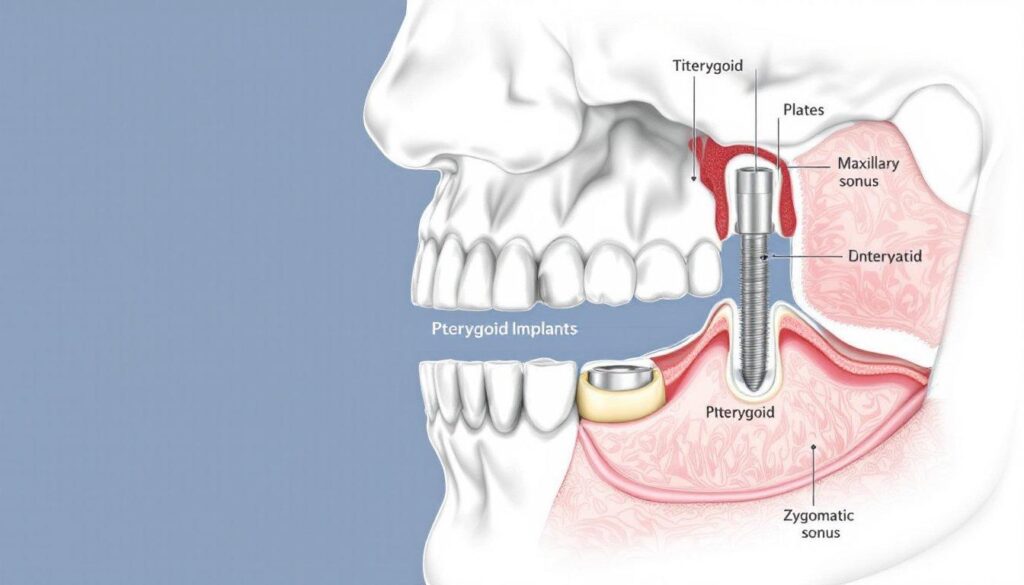
Pterygoid implants can help you avoid a sinus lift when you need upper-jaw implants and a 3D scan shows a safe path to strong bone behind the sinus. For some people, choosing pterygoid dental implants in Plymouth means posterior support for a full-arch bridge without a separate bone-grafting stage.
The approach is specialized. Your remaining bone, sinus anatomy, health, and planned teeth all affect whether pterygoid placement is appropriate.
How Can Pterygoid Implants Avoid a Sinus Lift?
Pterygoid implants gain support beyond the thin bone beneath the back of the upper sinus. Their planned path reaches dense bone farther back, where an implant can support a restoration without first building up the sinus floor.
Where Do Pterygoid Implants Anchor?
A pterygoid implant starts near the rear of your upper jaw and travels at an angle through the maxillary tuberosity toward the pterygoid region. Its far end engages dense bone associated with the pterygoid plates, behind the usual molar implant sites.
That trajectory is precise. The clinician must plan both a safe route through your anatomy and an implant position that works with your future teeth. Dense bone at the endpoint is useful only if the implant can be placed and restored at a workable angle.
How Does Rear Support Help a Full-Arch Restoration?
A full-arch bridge needs support across its length. Placing an implant near the back of your upper jaw increases the distance between the front and rear supports, reducing the need for a long, unsupported extension behind the last implant.
Your restorative plan determines how much rear support is needed. A pterygoid implant is commonly paired with implants farther forward; the positions should be chosen around the intended bridge and the way you bite.
Who Might Be a Candidate?
You may be a candidate when bone beneath the back of your sinus is too shallow for a planned conventional implant and the pterygoid region offers a safe anchoring path. A 3D scan and restorative assessment establish whether that combination applies to you.
When Does Upper-Jaw Bone Loss Make Standard Implants Difficult?
After upper molars are lost, the surrounding jawbone shrinks. The sinus can also occupy more of the space above the former tooth roots. Together, those changes leave less vertical bone for a conventional implant in the rear upper jaw.
If an implant at the desired molar position would lack adequate bone support, your clinician may consider a sinus lift, a shorter or tilted implant, or a different anchoring site. The choice also depends on where your replacement teeth need to sit, not solely on the amount of bone visible on a scan.
What Does a 3D Scan Need to Show?
A cone-beam CT scan needs to show a feasible implant path, sufficient bone for anchorage, and the location of the sinus and other nearby structures. Your clinician uses it to assess implant length and angle before deciding whether pterygoid placement fits the proposed restoration.
Ask to see where the back implant would start and where it would anchor. The scan should also inform whether your planned bridge will be accessible for cleaning, since the rear attachment sits in a harder-to-reach area.
What Should Patients Expect From Treatment?
Your treatment begins with a coordinated surgical and restorative plan. Placement requires specialized access and positioning; recovery and the timing of your final teeth depend on implant stability and healing.
How Are Placement and Recovery Planned?
Your team will review your health history, scan, bite, and proposed tooth positions before surgery. They will also discuss anesthesia, any teeth that need removal, and whether a temporary restoration is appropriate. A temporary bridge placed soon after surgery requires sufficient initial implant stability and a suitable bite.
Expect instructions for cleaning the surgical area, eating during early healing, and attending follow-up visits. Keep those visits even if you feel comfortable: your clinician needs to check healing and the restoration before you put full chewing pressure on the implants.
What Are the Risks and Alternatives?
Pterygoid placement involves surgical risks, including bleeding, infection, sinus complications, and implant failure. The deep rear position also makes placement and daily cleaning more demanding. Your clinician should explain how your anatomy affects those risks and who will perform the surgery.
|
Consideration |
Pterygoid placement |
Sinus lift + conventional implants |
Short or tilted implants |
|
Support site |
Bone behind upper jaw |
Grafted posterior jawbone |
Available upper-jaw bone |
|
Sinus graft |
Avoided with a suitable path |
Required |
Avoided with a suitable plan |
|
Treatment sequence |
Implant placement without sinus-graft healing |
Graft healing may add a stage |
Depends on implant plan |
|
Main planning constraint |
Safe rear trajectory |
Graft and sinus health |
Available bone and bridge position |
Zygomatic implants are another option in complex upper-jaw cases. Each approach has different surgical demands, so ask which options your scan supports and how each would affect your bridge and treatment schedule.
Choosing the Right Upper-Jaw Implant Approach
The right approach gives your planned teeth reliable support through a surgical path suited to your anatomy. Pterygoid placement can eliminate a sinus-lift stage when your scan shows safe rear anchorage and your restoration benefits from that position.
If you are considering upper-jaw implants in Plymouth, WI, ask for a scan-based comparison of the feasible plans. You should leave that discussion knowing where each implant would anchor, who would place it, and what recovery and cleaning will require.