
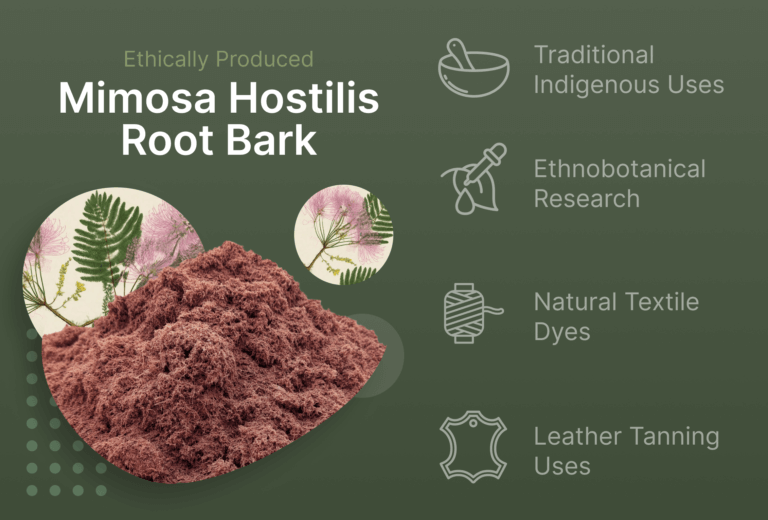
Natural botanical materials can vary considerably even when they originate from the same plant species. Differences in plant age, growing environment, root structure, drying, processing, and storage can all influence the final appearance and physical condition of root bark.
Mimosa tenuiflora is the botanical species commonly associated with the historical name Mimosa hostilis. Its root bark has been discussed in botanical, ethnobotanical, and historical literature, particularly in relation to its natural distribution across parts of Latin America.
When researching Bulk mimosa hostilis root bark for sale, it is useful to separate commercial terminology from botanical facts. Quantity describes the amount of material, while characteristics such as species identity, plant part, physical form, and geographic origin provide information about the material itself.
The Plant Behind the Name
Mimosa tenuiflora belongs to the Fabaceae family and the Mimosa genus. It is generally described as a woody shrub or small tree, although its growth form can vary according to environmental conditions.
The species has compound leaves made up of numerous small leaflets. Its branches may develop thorns, while flowers and seed-bearing pods provide additional characteristics for identifying an intact specimen.
These features are useful when examining the living plant. Once the material has been reduced to isolated root bark, however, most of these botanical characteristics are no longer visible.
From Mimosa Hostilis to Mimosa Tenuiflora
Scientific plant names sometimes change as taxonomic research develops. Mimosa hostilis is a historical name that remains widely recognized, while Mimosa tenuiflora is commonly used in contemporary botanical references.
This explains why both names can appear in older books, scientific discussions, archived documents, and online resources.
Understanding the naming history is useful when researching Mimosa hostilis root bark, because information published at different times may use different terminology for the same botanical source.
Root Bark as a Distinct Plant Component
Roots have several biological functions. They anchor plants within the soil and participate in water and mineral uptake.
As woody roots mature, their outer tissues become increasingly specialized for protection. These tissues form the bark associated with the root.
Root development is influenced by the surrounding soil and environmental conditions. Moisture, drainage, temperature, microorganisms, and root maturity can all affect the physical structure of underground tissues.
Consequently, bark from different sections of a root system may naturally vary in thickness, density, texture, and fiber arrangement.
Why Bulk Material Can Show Natural Differences
Large quantities of botanical material should not be expected to have perfectly identical characteristics.
A bulk quantity may contain material from different root sections or plants with different developmental histories. Environmental variation can also influence the appearance of individual pieces.
Differences may occur in:
- Bark thickness
- Fiber structure
- Density
- Surface texture
- Brown coloration
- Particle dimensions
Such variation is a normal feature of naturally derived plant material and does not automatically indicate that different species are present.
Geographic Background of the Species
Mimosa tenuiflora is strongly associated with northeastern Brazil and occurs in other regions of Latin America.
Its natural distribution includes areas where rainfall can change substantially throughout the year. Some environments experience pronounced dry seasons, while others receive more regular precipitation.
Soil composition, temperature, water availability, sunlight, and drainage influence how plants develop.
These environmental differences can contribute to variation in root characteristics between geographical populations.
Geographic origin therefore provides useful context, although location alone cannot establish botanical identity.
The Transformation From Fresh Root to Dried Bark
Fresh plant tissue contains considerable moisture and has a different structure from dried material.
During drying, water is removed from the tissues, causing the root bark to become firmer and generally more brittle. Its overall mass decreases, while surface characteristics can become more noticeable.
The conditions used during drying can influence the resulting material. Temperature, airflow, humidity, and drying duration may all affect the final physical state.
For this reason, drying should be regarded as an important part of the botanical material’s processing history.
Different Physical Forms of Root Bark
Root bark can exist in several physical formats depending on how extensively it has been processed.
Large pieces retain irregular edges, fibers, layers, and other structural characteristics. Breaking the material creates smaller fragments, while further mechanical reduction produces increasingly fine particles.
A simplified sequence is:
Root bark → dried sections → fragments → coarse particles → fine powder
Processing changes physical form without changing the botanical species.
The more extensively the material is reduced, the less recognizable the original root structure becomes.
Particle Size and Surface Area
Particle size has practical physical implications.
A large piece of bark has relatively limited surface exposure compared with the same amount divided into many smaller particles. Grinding therefore increases the total surface area substantially.
This can affect how fine botanical material interacts with surrounding air.
Humidity becomes particularly relevant because small particles have a greater exposed surface. Under humid conditions, fine material may become less free-flowing or develop clumps.
Particle size should therefore be considered when describing the physical condition of processed root bark.
Understanding Color and Texture
Color and texture are useful descriptive characteristics, but they should not be overinterpreted.
Root bark can display various earthy brown shades. Its appearance may be influenced by plant maturity, geographic origin, drying, processing, exposure to air, and storage.
Texture can similarly range from fibrous and woody in larger pieces to more uniform in finely processed material.
Because multiple factors influence appearance, color or texture alone cannot provide definitive botanical identification.
Why Processing Reduces Identification Information
An intact Mimosa tenuiflora specimen offers numerous features for botanical examination.
These include:
- Leaves
- Leaflet arrangement
- Branches
- Thorns
- Flowers
- Seed pods
- Bark
- Growth form
- Habitat
Isolated root bark contains only some of these characteristics.
Further processing removes additional information. Fine powder has very little recognizable morphology, making visual identification considerably more limited.
This creates an important distinction between describing a material’s appearance and scientifically establishing its botanical identity.
Storage Considerations for Dried Root Bark
Storage conditions can influence the physical state of dried botanical material.
Humidity is particularly important. Fine particles have substantial surface exposure and can interact with moisture present in surrounding air.
Extended exposure to unfavorable humidity may result in:
- Clumping
- Texture changes
- Unexpected dampness
- Unusual odors
- Conditions favorable to microbial deterioration
A clean, dry, and stable environment is generally appropriate for preserving dried plant materials.
Excessive heat and prolonged direct sunlight should also be minimized.
Packaging and Handling Larger Quantities
Packaging helps separate botanical material from its surrounding environment.
For larger quantities, suitable containment can reduce unnecessary exposure to moisture, dust, insects, and physical contaminants.
Clear labeling is equally important.
A useful label or record can identify the scientific name, historical name, plant part, physical form, quantity, geographic information, and storage date.
Good documentation becomes increasingly valuable when multiple botanical materials are handled in the same facility.
Botanical Traceability
Traceability refers to maintaining information about the history of a botanical material.
A useful record can connect the material with its:
- Scientific identity
- Historical name
- Plant part
- Geographic origin
- Processing form
- Quantity
- Handling history
- Storage conditions
This information provides context that cannot be established through appearance alone.
It can also help researchers compare contemporary materials with older botanical records that use historical terminology.
Commercial Terminology Versus Botanical Information
Online descriptions often combine scientific names with commercial phrases.
For example, Bulk mimosa hostilis root bark for sale is a search-oriented phrase describing quantity and availability rather than a botanical specification.
A more scientific evaluation would focus on the species name, plant part, source region, physical form, processing history, and storage condition.
This distinction helps prevent commercial terminology from being confused with evidence about botanical identity or material characteristics.
Natural Variation Versus Deterioration
Not every difference in dried root bark indicates a problem.
Natural variation can involve differences in color, fiber content, density, thickness, and particle size.
Deterioration presents different characteristics. Visible mold, unexpected dampness, insect contamination, or persistent unusual odors may indicate unfavorable storage or contamination.
Distinguishing these conditions is important when evaluating naturally derived botanical materials.
Ecological Importance of Mimosa Tenuiflora
The natural ecology of Mimosa tenuiflora provides useful background for understanding its physical variation.
The species is associated with seasonally dry environments across parts of Latin America. These habitats can experience substantial changes in rainfall and soil moisture.
Plant development under such conditions can influence root growth and overall structure.
Studying the ecology of the species therefore helps explain why botanical materials from different environments may not appear completely identical.
Ethnobotanical Background
Mimosa tenuiflora has also been documented in ethnobotanical literature.
Ethnobotany examines historical relationships between people and plants, including traditional knowledge, local plant recognition, and cultural interactions with vegetation.
These records provide historical and cultural context for the species.
However, historical ethnobotanical information should be distinguished from modern scientific evidence when evaluating contemporary claims concerning safety or effectiveness.
Comparing Common Root-Bark Forms
|
Physical form |
General characteristics |
Visible structure |
|
Large bark pieces |
Irregular woody sections |
High |
|
Dried sections |
Firm pieces with visible fibers |
High-moderate |
|
Fragments |
Broken smaller pieces |
Moderate |
|
Coarse particles |
Mechanically reduced material |
Low |
|
Fine powder |
Highly divided particles |
Very low |
The table illustrates how processing gradually reduces recognizable botanical structure.
Frequently Asked Questions
What is Mimosa Hostilis Root Bark?
It refers to root-bark material associated with Mimosa tenuiflora, historically known as Mimosa hostilis.
Is Mimosa hostilis the current botanical name?
Mimosa tenuiflora is commonly used in contemporary botanical references, while Mimosa hostilis is a historical name.
Why can root bark differ between samples?
Plant age, root maturity, geography, soil, climate, drying, processing, and storage can all influence its characteristics.
Does a bulk quantity represent a separate plant variety?
No. Bulk describes quantity rather than botanical classification.
Can color establish botanical identity?
No. Color alone cannot reliably identify a plant species.
Does grinding change the botanical source?
No. Grinding changes the physical form without changing the taxonomic identity.
Why does particle size matter?
Smaller particles have greater surface exposure and can interact more readily with environmental humidity.
What affects the storage condition of dried bark?
Humidity, temperature, light exposure, contamination, and packaging can all influence its condition.
Where is Mimosa tenuiflora associated with naturally?
It is strongly associated with northeastern Brazil and other regions of Latin America.
What family does the species belong to?
Mimosa tenuiflora belongs to the Fabaceae family.
Conclusion
Bulk Mimosa Hostilis Root Bark is best understood as naturally derived botanical material shaped by the biology of Mimosa tenuiflora, its environmental conditions, and the physical processes applied after harvesting.
Differences in root maturity, geography, color, texture, and structure are expected in plant-derived material. Drying and mechanical processing further change the physical form, while humidity and storage conditions can influence the material after processing.
A useful botanical assessment therefore considers species terminology, plant anatomy, geographical origin, processing stage, particle size, storage, and traceability together. This provides a more informed understanding of bulk root bark while recognizing the limitations of judging botanical identity from appearance alone.